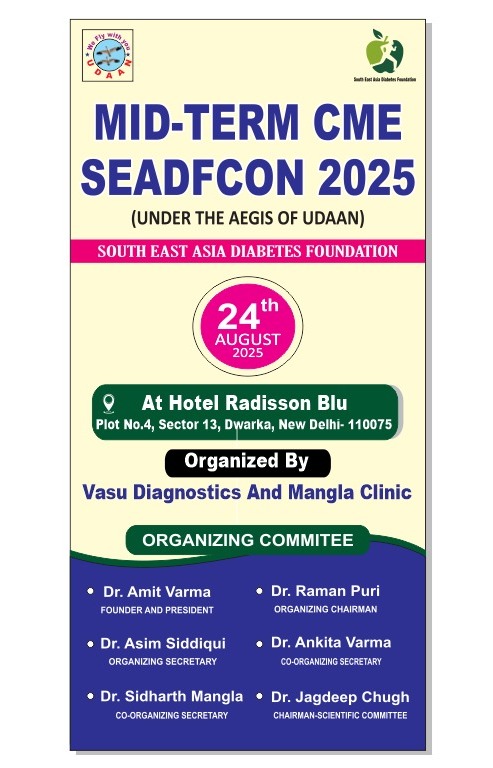
Seminar Summary: SEADF Punjab Chapter
A seminar convened by the Southeast Asian Diabetes Foundation (SEADF) Punjab chapter, focusing on clinical case management and advanced therapies for diabetes. The proceedings featured two main sessions: a clinical case study on syndromic diabetes and a panel discussion on beta cell therapies.
Session 1: Clinical Case Presentation
The first session featured a case presentation of a 16-year-old male previously diagnosed with type 1 diabetes.
Case Findings
The patient exhibited obesity, hyperphagia (excessive food seeking), intellectual disability, and hypogonadism, alongside dysmorphic features like almond-shaped eyes.
Diagnosis
Clinical evaluation and genetic testing confirmed Prader-Willi syndrome.
Management
Treatment included metformin, a GLP-1 agonist for glycemic control and appetite regulation, and testosterone replacement.
Key Learning
Physicians should suspect syndromic diabetes if a young patient presents with obesity and developmental delays, particularly if there is an absence of traditional type 1 or type 2 diabetes markers.
Session 2: Panel Discussion
The second session, titled “Beta Cell: Bringing Back the Beta Cells by Replacement or Regeneration,” explored the potential for curing type 1 diabetes.
Unmet Needs
Experts emphasized that while current insulin delivery technology is advanced, it remains inferior to natural, endogenous beta cell function, which provides minute-to-minute physiological regulation.
Replacement Strategies
The panel discussed whole pancreas transplantation and islet cell transplantation (such as the FDA-approved Lantidra). While these procedures can offer insulin independence, they are often limited by donor availability, high costs, and the necessity of lifelong immunosuppression.
Regenerative Future
The discussion highlighted emerging stem cell-derived therapies (e.g., Vertex’s VX-880 trial) and pharmacological approaches (e.g., harmine) as the next frontier.
Critical Caveat
Experts noted that regeneration alone is insufficient for type 1 diabetes; it must be coupled with strategies to stop the ongoing autoimmune process to avoid “refilling a leaking tank”.